


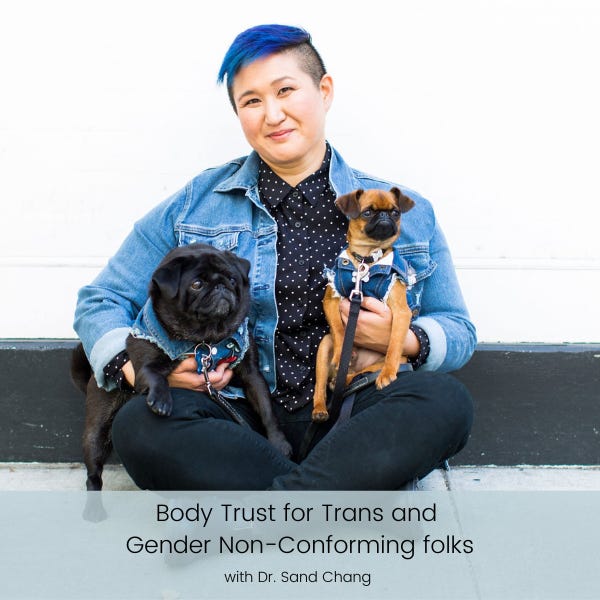
Body Trust for Trans and Gender Non-Conforming Folks | Episode 39
Description
Dr. Sand Chang (they/them/their) is a Chinese American nonbinary clinical psychologist, DEI consultant, and somatic psychotherapist with more than 20 years of experience providing training and mental health services in a variety of settings, including the corporate sphere, startups, community mental health, university counseling, public schools, nonprofits, and medical centers. As a DEI trainer/educator and consultant, Dr. Sand strives to bring an intersectional, trauma-informed perspective to help workplaces create inclusive and psychologically safe(r) environments.
This episode we discuss
🌈Understanding the value of lived experience
🌈Trans-masc and non-binary body image and acceptance barriers
🌈Misgendering and other sources of minority stress
Episode Resources
Episode edited and produced by Unapologetic Amplified
This transcript was generated with the help of AI. Becoming a supporting member helps us improve accessibility and pay equitable wages for things like human transcription.
Have you ever wondered why almost all the health and wellness information you see out there is so white, cis able-bodied and het? I know I have. And as a queer black registered dietitian, I gotta tell you, I'm not into it. I believe health and happiness should be accessible to everyone. That is precisely why I wrote Decolonizing Wellness: A QTBIPOC-Centered Guide to Escape the Diet Trap, Heal Your Self-Image, and Achieve Body Liberation and why I host Body Liberation for All.
The road to health and happiness has a couple of extra steps for chronically stressed people, like queer folks and folks of color. But don't worry, my guests and I have got you covered. If you're ready to live the most fierce, liberated, and joyful version of your life, you are in the right place.
Body Liberation for All Theme
They might try to put you in a box, tell them that you don't accept when the world is tripping out tell them that you love yourself. Hey, Hey, smile on them. Live your life just like you like it
It’s your party negativity is not invited. For my queer folks, for my trans, people of color, let your voice be heard. Look in the mirror and say that it's time to put me first. You were born to win. Head up high with confidence. This show is for everyone. So, I thank you for tuning in. Let's go.
Dalia: I'm so happy to have you here. I am always looking for people who are focusing on serving LGBTQIA plus people, preferably BIPOC but it's sometimes really hard to find, I don't know if this happens as much for other folks of color, but among Black folks, the homophobia is next level and the transphobia is like - it just makes you wanna gouge your eyes out. And so, you may struggle just to find a BIPOC person who offers the healing services that you need, but then finding one that's not gonna be transphobic intentionally or unintentionally, cuz that's just not their focus, it's not their interest, it really is a whole nother layer.
It's so exciting to see that you're out here leading with your marginalized identities. How did you get to this point? Because I know for me it wasn't overnight. How do you feel like being a Chinese American person and a non-binary person influenced your worldview?
Dr. Sand: Oh gosh. I mean, that's a big question. I kind of wanna go back cuz what you, something you just said was so real. Like just, you know, within our own communities facing these different aspects of white supremacy, colonialism, oppression, and yeah, you don't have to be white to enact white supremacy. You don't have to, you know, it's like all this stuff is in the air and we're indoctrinated into these systems.
And so, it's sometimes so hard to find like a truly intersectional liberation space and you know, to go to your question, I don't know that I, like ever thought to myself, oh, I wanna do this kind of work. I, I think I just like, as a young person, was really interested in people and trying to understand people and trying to understand dysfunction, to be honest.
you know, the dysfunction that was around me. And I don't even wanna use that language, you know, I kind of feel like that's, in some ways amidst language, but like, let's say like the chaos that that, that I witnessed and wanted to understand. And in coming into these like professionalized spaces, people would come to me and say like, oh, like you, you're Asian.
Like, tell me about Asian people. Or, oh, you're queer. Tell me about queer people.
Dalia: Like all of the Asian people??
Dr. Sand: be the spokesperson, right? And so that's like that burden of representation and the burden of needing to, to, I don't know, somehow be an expert, even if I'm not an expert. I mean, how could I possibly be an expert on all things Asian?
Right.
Dalia: How could one person know all the things about the global majority? Yeah. Like at this point, I don't understand how anybody's., when you really think about it from a global majority perspective, I feel like the response should be, I don't know, get a book like these are really old cultures, it's beyond one person's ability to kind of summarize something so vast, and why should one person have to school people on what the global majority is up to?
Dr. Sand: Right, right. So, there's these expectations. There are a gazillion invitations to be on everyone's diversity committee and all the trauma of those experiences. And there's just the ways that my lived experience shaped me to not be an expert on any kind of population, but to kind of know how to navigate or know what to expect when I'm interacting with these really fucked up systems, right? And so, like, sometimes I say like,I'm not expert on trans people, you know, being a non-binary trans person.
I wouldn't ever say I'm an expert on this, but I do think, like I do have a lot of expertise navigating systems of transphobia and especially working within trans health and working in systems that really enact all these colonialists and white supremacist, you know expectations around gender and gender expression and bodies.
So anyway, I don't know if that's exactly answering the question, but yeah, I didn't, you know, wake up one day and think like, I wanna be a DEI consultant, you know, like, it's actually not really easy work. And sometimes I think it's impossible work. And then I have another part of me that's like, oh no, like there's this hope and there's this vision there for a different kind of world, and how could I contribute to co-creating that in whatever small ways that I can.
But yeah, a lot of days it's, it's hard.
Dalia: It's helpful to hear that from somebody who's been doing this work for so long, because I know, I see all the time things that I want to help maybe individual clients with over time it becomes obvious that it can't be solved on an individual level, it can only be coped with and so, then you feel drawn to try and push against the systems. And so, things like DEI consulting,it feels like a natural step, but then once you actually get into these spaces you don’t find it as positive as you’d hoped.
Dr. Sand: Yeah. I've been thinking a lot about like, what is the trauma you experience in these oppressive contexts that don't even.
what they're doing. And then what is the trauma or the pain of being in performative DEI spaces, like situations where people or organizations try to use white supremacy to solve white supremacy. So, like that's just kind of like encapsulates 2020 up to today.
Dalia: Yeah. Like this, the racial reckoning that was, it was so frustrating while we were in, it was people acting like no one had ever tried to bring these issues to light.
And I'm like, oh, I'm sorry. What? You missed the entire 1960s.
Dr. Sand: Yeah. Yeah.
Dalia: And for people to say they wanted people to express their frustration and heartbreak in a particular way and kept propping up MLK, as this is the proper way for marginalized people to say, stop killing us. And when I refresh people's memory, I'm like, okay and he said it politely the way you wanted him to and what happened to him? How did that end?
There's no way to tell people who are deeply invested in white supremacy the reality of what it does to people, and it be palatable. Like it just isn't if you're attached to it and deeply invested in it.
There’s no way we can say it that would make it easy to swallow. Yeah. And it was just interesting to me how quickly people. Put everything aside. And I don't think I ever noticed, and it could have just been me not paying enough attention, how frequently people will pick up on a social justice movement that's existed for decades and will have to continue to exist because true change has not happened.
But how corporations, businesses, people who aren't directly affected by the problem will act as though they can only focus on one issue at a time. So, when people had BLM on their mind, they were like, oh, anti-Asian violence I can't, I can't understand. I, I, I don't un




 United States
